
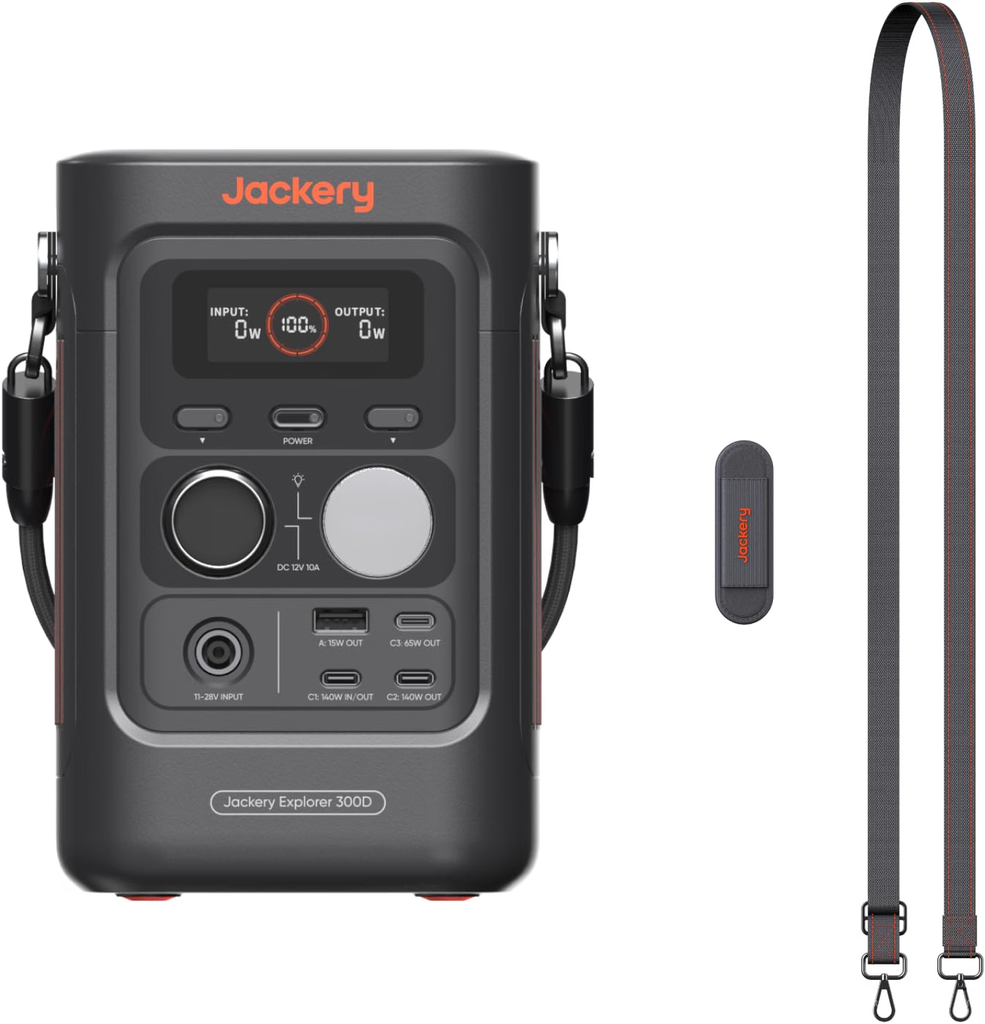
The Jackery Explorer 300 Plus is one of the best-known small portable power stations. It packs a 288Wh LiFePO4 battery and a 300W AC outlet into a body that weighs about 8 pounds, which makes it a popular pick for camping, road trips and light emergency backup. In this review we look at its specs, what it can run, how long it takes to charge, where it falls short and which alternatives are worth a look.
Check the Jackery Explorer 300 Plus on Amazon
Quick Verdict
Good for: Phones, laptops, cameras, LED lights, small fans and a small 12V fridge for a few hours, in a very light package.
Not for: Anything over 300W, such as kettles, hair dryers, heaters or most blenders, or for anyone who needs several nights of backup.
The short answer: It is a light, well-built LiFePO4 unit that does its small job well. The main trade-offs are a single 300W outlet, a two-hour wall charge that is slower than some rivals, and the need for an adapter to use solar panels.
Which Jackery Explorer 300 Is This?
Jackery has used the “Explorer 300” name for more than one model, so check the product page carefully before you buy:
- Explorer 300 (original): An older model with a lithium-ion battery of about 293Wh.
- Explorer 300 Plus: The model this review covers. It has a 288Wh LiFePO4 battery and a 300W AC outlet, and it weighs about 8.27 pounds.
- Explorer 300 (current) and Explorer 300 v2: Newer versions that Jackery sells today. Reports describe the current Explorer 300 as having about 292Wh of LiFePO4 with two AC outlets at about 7.5 pounds, and the 300 v2 as charging faster. Specs for these newer models differ from the 300 Plus, so check their listings if you are comparing.
Some sources report that Jackery’s own US store no longer lists the 300 Plus, so check that it is available on Amazon, and compare it with the newer models, before you buy.
Jackery Explorer 300 Plus Specs
| Spec | Jackery Explorer 300 Plus |
|---|---|
| Capacity | 288Wh |
| Battery | LiFePO4 (lithium iron phosphate) |
| AC output | 300W continuous, 600W surge |
| AC outlets | Reported as one on most sources, so check the listing |
| USB-C | 100W Power Delivery (input and output), plus a second 15W port on some listings |
| Other ports | USB-A and a car (12V) port |
| Weight | About 8.27 pounds (3.75 kg) |
| Size | About 9.1 x 6.1 x 6.6 inches |
| AC charge time | About 2 hours |
| Solar input | Up to 100W, and about 4 to 4.5 hours with a 100W panel |
| Extras | LCD screen, app control and a quick-switchover (EPS) mode on some sources |
Specs come from Jackery, published reviews and Amazon listing text, and some sources disagree on details such as the port count and solar adapter. Check the product page for the latest specs.
What Can It Run?
At 300W continuous, the 300 Plus suits small loads. Typical examples:
| Device | Typical running power | Fits a 300W unit? |
|---|---|---|
| Phone charging | 5 to 20W | Yes |
| LED lights | 5 to 20W | Yes |
| Laptop | 50 to 90W | Yes |
| Fan | 20 to 60W | Yes |
| TV | 50 to 100W | Yes |
| 12V or small mini fridge (average draw) | 40 to 100W | Yes, for a few hours |
| CPAP (no heated humidifier) | 30 to 60W | Yes, for about one night |
| Blender, kettle, hair dryer | 300 to 1500W | Usually no |
Runtime estimates
Use this formula: hours = capacity (Wh) x 0.85 / device watts. The 0.85 allows for energy lost in the inverter. For the 288Wh battery:
| Load | Estimated runtime |
|---|---|
| 10W (phone charging) | About 24 hours |
| 50W (laptop) | About 5 hours |
| 40W (small fridge or CPAP) | About 6 hours |
| 100W (several devices) | About 2.4 hours |
| 300W (maximum load) | About 50 minutes |
These are estimates, not guarantees. Real runtime changes with temperature, battery age and how efficiently your devices run. One tester reports that power drains quickly with a high-drain device like a gaming laptop.
Design and Portability
The 300 Plus has an integrated handle and a compact case, and weighs about 8.27 pounds. Jackery describes it as about as heavy as a rigid plastic lunch box, and a review calls it the lightest LiFePO4 unit in Jackery’s lineup. It fits in a backpack or a car footwell, which makes it a good fit for camping and road trips.
The front has a monochrome LCD screen showing input and output watts and battery level, and the unit also works with Jackery’s app.
Charging
Wall charging: Reviews report about two hours for a full charge using the included AC cable. That is quicker than the original Explorer 300, but slower than some rivals. Trusted Reviews notes that the similar-capacity EcoFlow RIVER 2 can fully recharge in about an hour.
Solar charging: The 300 Plus accepts up to 100W of solar input and charges in about 4 to 4.5 hours with a 100W panel in strong sun. Some reviewers note that you need an adapter to connect a solar panel. Check the listing to see whether one is included.
USB-C charging: The 100W USB-C port also works as an input, which is handy for charging from a compatible charger.
Battery Life
The 300 Plus uses LiFePO4 chemistry, which is known for long cycle life and good thermal stability. Sources quote different cycle counts, from about 2,000 to 3,000 cycles, and Jackery says the battery is designed to last up to 10 years. Check the warranty on the product page, and note that one review lists the 300 Plus with a 5-year warranty.
Pros and Cons
Pros:
- Very light and compact at about 8.27 pounds
- LiFePO4 battery with a long rated life
- 100W USB-C Power Delivery input and output
- About two hours for a full wall charge
- LCD screen and app control
- Jackery lists safety certifications including UL on its product page
Cons:
- Small 288Wh battery, so limited runtime
- 300W output rules out many appliances
- Reported single AC outlet
- Wall charging is slower than some rivals
- May need an adapter for solar panels
- Availability can vary, because the model may be replaced by newer versions
How It Compares
| Jackery Explorer 300 Plus | EcoFlow RIVER 3 | BLUETTI EB3A | |
|---|---|---|---|
| Capacity | 288Wh | 245Wh | 268Wh |
| AC output | 300W | 300W, X-Boost up to 600W | 600W, 1200W surge |
| Battery | LiFePO4 | LiFePO4 | LiFePO4 |
| Weight | About 8.27 pounds | About 7.8 pounds | About 10 pounds |
| Full charge | About 2 hours | About 1 hour | 0 to 80% in about 30 minutes |
Choose the Jackery Explorer 300 Plus if you want the largest battery of the three in a light, simple package.
Choose the EcoFlow RIVER 3 if you want faster charging and a slightly lighter unit. Check the EcoFlow RIVER 3 on Amazon
Choose the BLUETTI EB3A if you need more output for small appliances. Bluetti’s own site lists this model as discontinued, so check availability. Check the BLUETTI EB3A on Amazon
Choose a larger unit if you need more runtime. The Jackery Explorer 1000 v2 has a 1070Wh battery and a 1500W output in a relatively light body. Check the Jackery Explorer 1000 v2 on Amazon
Who Should Buy the Jackery Explorer 300 Plus?
Buy it if you:
- Want a light, simple backup for phones, laptops and lights
- Camp, travel or road trip and need a unit you can carry easily
- Want LiFePO4 battery chemistry in a small package
Skip it if you:
- Need to run appliances over 300W
- Want several nights of backup power or a full-size fridge
- Need multiple AC outlets or the fastest wall charging
Tips for Getting the Most from the 300 Plus
- Use the USB-C and DC ports when you can, since they waste less energy than the AC inverter.
- Charge it fully before a trip, and top it up every few months.
- Keep it in a cool, dry, shaded place. Do not leave it in a hot car.
- Pair it with a 100W solar panel for off-grid charging, and check whether an adapter is needed.
- Turn off devices you are not using, and avoid heating appliances.
Frequently Asked Questions
Is the Jackery Explorer 300 Plus worth it? For light use, yes. It is a lightweight LiFePO4 unit with a long rated battery life. If you need more output, faster charging or a bigger battery, look at the alternatives above.
How long does the Jackery Explorer 300 Plus take to charge? About two hours from a wall outlet, and about 4 to 4.5 hours from a 100W solar panel in strong sun.
What can the Jackery Explorer 300 Plus run? Phones, laptops, cameras, LED lights, small fans and a small fridge for a few hours. It cannot run anything over 300W.
Can it run a CPAP? It can often run a CPAP without a heated humidifier for about one night. Check your machine’s wattage, and ask your equipment provider for guidance.
What is the difference between the Explorer 300 and the 300 Plus? The 300 Plus uses a LiFePO4 battery and charges faster than the original Explorer 300, which uses a different lithium-ion chemistry and takes longer to charge. Jackery also sells newer Explorer 300 models, so check each listing.
Can I use it with solar panels? Yes, up to 100W of solar input. You may need an adapter to connect the panel.
Final Thoughts
The Jackery Explorer 300 Plus is a light, simple and well-regarded small power station. It is not the fastest to charge or the most powerful for its size, but its LiFePO4 battery, 100W USB-C port and 8-pound body make it easy to recommend for camping, travel and light backup. If you need more output, faster charging or more capacity, the alternatives above are worth a look.
Check the Jackery Explorer 300 Plus on Amazon
Stay powered! If this review helped, bookmark it and share it with a friend who is shopping for a small power station.
Disclosure: As an Amazon Associate I earn from qualifying purchases. If you buy through links on this page, I may earn a small commission at no extra cost to you.